Sunday, 8 April 2012

Thirteenth Entry: 'Splintered Sky' - Spoofs, terrorism, realistic attraction and a little liberal affirmation from Fox News

Splintered Sky, Don Pendleton, Worldwide publishing -p.91

    "Nobody else pops up on your radar as someone to watch?" Schwarz continued.
    "Well, there is this nosy engineer with a round face, but he's been grounded already," Komalko said with a wink.
    "Personal issues with Cole already?" Schwarz asked.
    "Cole wanted is pal, Armin Mustafa, to be placed as flight engineer in my place. Said this mission was no place for some hotshot and his kid sidekick," Komalko explained.
    Schwarz nodded.
    "I know Mustafa, and except for him being hooked up with a complete jerk, Armin's a decent guy. Another hard worker, quiet, gets along with everyone," Komalko said. "And they run all through deep background checks. I don't think he's al Qaeda."
    Schwarz shrugged. "I don't judge on names, Pie. I've been through enough to know that worrying about somone's name sounding vaguely like a paperback terrorist without solid foundation is just plain stupid. Never mind that I've worked with plenty of folks, and encountered the best and worst of everything, Arab, Asian, white, black. People are people. Some are dicks, some are just plain bad, but most are just folks doing their job."
    At that moment, a young, handsome black man came up the scaffolding.
    "Oh, Armi, we were just talking about you," Komalko said.
    "Hi," Schwarz greeted. "What's wrong?"
    "You guys had a problem with the old circuit board,: Mustafa answered. "I brought up a new one. You must be Miller, the new guy."
    "I am," Schwarz told him. "I guess you heard us talking."
    Mustafa shrugged. "I'm used to it by now. I've got a name that brings up some bad images to ignorant folks. Luckily, you're not ignorant."

 "...some hotshot..."
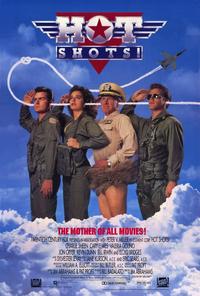


This is one of my favourite movies. The humour isn't high-brow - let alone cultured, but I guess that's why I love it. It's silly, slapstick, both predictable and not.


And of course, it spoofs 'Top Gun', the quintessential 1980's flick. Apart from the bravado, the jets, the soundtrack and the awesome ("Your ego's writing cheques your body can't cash") lines, one thing I really like about Top Gun is Maverick's (Tom Cruise) wooing of Charlotte (Kelly McGillis). He actually has to make an effort to build that attraction. So many shows and movies just undercut that process by having a female character more or less throw themselves at the male. He makes no effort, she initiates everything, makes every move, the male almost incidental to the entire scene. Now guys like this do  exist - they're handsome and just exude that, I don't know, magnetism to which females respond. I've seen it. With a 1980's Tom Cruise, that would have been both easy to write and convincing - but they didn't. Top Gun isn't the best written flick of all time, but I can appreciate the effort that the writers made in developing the attraction between guy and girl. It works and is preferable to simply making him an irresistible object that draws women like flies to a pig's backside.

"Mustafa shrugged. "I'm used to it by now. I've got a name that brings up some bad images to ignorant folks. Luckily, you're not ignorant."

In a post 9/11 world there are those who would make snap judgements about a person based on their name and/or religion. A few years ago, I recall a guy saying "Not every Muslim is a terrorist, but every terrorist a Muslim." What vacuous nonsense. Terrorist attacks against the United States have been perpetrated by Christian fundamentalists, Environmental and Animal Rights extremists, Far Right nutcases, crazy people as well as Islamist zealots - and continue to do so. The 9/11 attacks did not usher in a monopoly on the use of terrorism. Islam is painted as a dangerous religion that advocates violence and the total subjugation of women, especially by those whose leanings are to the right, or by current affairs programs whose ratings are dependent on sensationalised bullshit like Islamic extremism, rapacious landlords, dole bludgers and 'political correctness gone mad'. To quickly answer the common argument about Islam's treatment of women - I refer you to Diah Permata Megawati Setiawati Sukarnoputri, former President of Indonesia - the world's most populous Muslim country. Now, I am not defending countries like Saudi Arabia, whose treatment of women is deplorable, only saying that an entire religion and culture cannot be summarised and judged so conveniently.
    One of my favourite episodes of 'The West Wing' is 'Isaac and Ishmael'. It is an episode that was aired at the beginning of the third season and separate from the series' continuity. It deals with the September 11 attacks. Terrorism is explored by the characters as is the propensity for profiling and prejudice in 9/11's wake. It is a grounded episode that remains calm in its exploration of the issues, facts being delivered succinctly and without nationalistic fervour. It is an episode that makes me proud to be human, as it was exactly the calming influence that many needed at that time.


"Islamic Extremist is to Islam as the KKK is to Christianity." That is powerful stuff, a sentiment that has not been articulated enough.

Speaking of the navy and the West Wing, I can't help but bring up one of my favourite supporting characters, Admiral Fitzwallace.


So true. Look! Even Fox News agrees! Jump to 2:30.


Didn't see that coming, did you?

Thursday, 22 March 2012

Twelfth Entry: 'The Waves' - 30

The Waves - Virginia Woolf, CRW Publishing, 1931 - p.244

...eclipse when the sun went out and left the art, flourishing in full summer foliage, withered, brittle, false. Also I saw on a winding road in a dust dance the grounds we had made, how they came together, how they ate together, how they met in this room or that. I saw my own indefatigable busyness - how I had rushed from one to the other, fetched and carried, travelled and returned, joined this group and that, here kissed, here withdrawn; always kept hard at it by some extraordinary purpose, with my nose to the ground like a dog on the scent; with an occasional toss of the head, an occasional cry of amazement, despair and then back again with my nose to the scent. What a litter - what a confusion; with here birth, here death; succulence and sweetness; effort and anguish; and myself always running hither and thither. Now it was done with. I had no more appetites to glut; no more strings in me with which to poison people; no more sharp teeth and clutching hands or desire to feel the pear and the grape and the sun beating down from the orchard wall.
    'The woods had vanished; the earth was a waste of shadow. No sound broke the silence of the wintry landscape. No cock crowed; no smoke rose; no train moved. A man without a self, I said. A heavy body leaning on a gate. A dead man. With dispassionate despair, with entire disillusionment, I surveyed the dust dance; my life, my friends' lives, and those fabulous presences, men with brooms, women writing, the willow tree by the river - clouds and phantoms made of dust too, of dust that changed, as clouds lose and gain and take gold or red and lose their summits and billow this way and that, mutable, vain. I, carrying a notebook, making phrases, had recorded merely...

I was recently prompted to evaluate my life so far, most specifically my post-high school years - apparently turning 30 does that to people. Many have a fear of that age, I guess it comes from a societal expectation of achievement by then; a stable relationship (if not, marriage), a degree, career prospects - all the stuff that people picture when people say 'he's doing well'. The trajectory of my twenties didn't really follow that of my friends: I dropped out of uni, spent many years working behind bars, moved states a couple of times, spent a year overseas and then returned to study as a 'mature age student', with graduation now a couple of months away.
   In many ways it would be easy to lament the choices I made and the way in which I lived, and in some cases I still do - that's part of growing up. But I've been largely comfortable with my age now beginning with a '3'. I had more issues when I turned 25 - I recall sitting on my bed with my hand on my head for half an hour at a time, questioning everything about my existence. Not so this milestone (and I use that word loosely) around. At the time, I didn't really have much of an idea of where I was heading or what I was going to do with my life. A year overseas, more specifically, 7 weeks bumming around Europe, meeting different people and spending 9 hour train rides marveling at the old world with mainly my thoughts as company, fostered a determination, and a resolve, that had been missing for some time. That and a drunken accident of the greatest stupidity (my own). I suppose that's why I'm comfortable with 30, because I know that I'm in a better position to launch into my future than I was 5 years ago. 
    On the day my twenties ended and my thirties began I wrote and published this on my facebook page,

 To my twenties,
Today we go our separate ways. During our time together, you introduced me to new people, to the world and to life. We were subject to experiences full of both wonder and pain, love and heartbreak, fun and misery, excitement and utter boredom. Together we traveled and engaged, took advantage of opportunity, made friendships short-lived and everlasting. Our coexistence will be forever remembered, not only by the various scars you have left on my body, but by memories that span the emotional spectrum. Thank you for everything, without you I wouldn't be here today.

That decade was interesting and a lot of fun. There are some things that I regret and would have liked to have done differently, but they're done now and can't be altered, so I don't linger over them. Is that what people fear about turning 30, being forced into a confrontation with not only their past but their future? Does my current ease only exist because I've already dealt with these issues before? Or does it come from a little line that I periodically repeated to myself during travels and the subsequent years: "Dwell for a moment, learn for a lifetime and get the fuck on with it"? 

Who knows, yes and maybe. But at the moment it's peachy and I'm working towards a better life - a position which I am fortunate enough to be in - another reason for my comfort: travel and education exposes one to a world that isn't at all fair. I'm extremely lucky to live where I do - a stable democratic state, where opportunity exists for self-betterment. The fact that I've turned 30, can reasonably expect to live much longer and decide which direction to steer my life is something to be celebrated, not feared, lamented or cried over.

Sunday, 4 March 2012

Eleventh Entry: 'Case and the Dreamer' - Creationism, mutants and Mormon missionaries' mind altering experience

Case and the Dreamer: Volume XIII: The Complete Stories of Theodore Sturgeon - North Atlantic books, Berkeley, California, 2010 - p.117

The most exciting thing that ever happened to Harry (aside from rheumatic fever and Susan) was the evening he spent with Timothy Leary.  After that - well, you'll judge for yourself, but before, things had been pretty quiet for Harry.
    Dr. Leary came swinging into Woodstock, New York, bringing with him two younger men, Metzner and Alpert, with shiny shoes, pants with creases, and sharing a professorial rather humorless air.  They reminded Harry of divinity students, straight-spined, quick-minded, with his charisma and his resonant voice; Leary was something else again.
    He used words like "psychotomimetic" and a brand-new one, "psychedelic," and fielded questions like "If I knocked and the door was opened by a man who had taken LSD, what would you look like?"and "Is it addictive?" openly and immediately, all of which interested Harry quite a lot, but it wasn't until afterward, at the Cafe Espresso across the street, that Harry achieved the highest-yet peak of excitement.
    Over cappuccino, Dr. Leary held forth about mutations.  "There are three kinds of mutations, " said Leary.  "Lethal ones, and you can mostly forget about them.  They cause stillbirths, and when they don't, the young seldom survive, and when they do, they seldom reproduce - they're mules, they just don't live long enough to mate.  Then there is the beneficial mutation - saying a herd animal, when one is born with longer and stronger legs.  This one gets away from the predators better than any of the others, and passes the strain on.  The descendants thrive, and in a few, or a dozen generations, you'll find a whole herd with the new legs.
    "But there's a third kind of mutation.  It's the one that just means...

"...bringing with him two younger men, Metzner and Alpert, with shiny shoes, pants with creases, and sharing a professorial rather humorless air.  They reminded Harry of divinity students..."

They are sometimes a nuisance, they can incite bitter ire and to some they deliver word of salvation.  


Most people are content to close the door with varying degrees of abruptness, but in 1999 a couple of guys in Melbourne, Australia, invited two Mormon door-knockers into their home for an enlightened discussion over refreshment and biscuits.  After their visit, the boys weren't feeling well, so admitted themselves to hospital.  The diagnosis?  Stoned.  The charming hosts had fed them a freshly baked batch of hash cookies and somehow managed to keep a straight face.

"There are three kinds of mutations."

This statement is broadly supported by film, comic and television industries.  The three main type of mutants and mutations are characterised by:

The X-Men


To quote Professor X from the first X-men film: "Mutation: it is the key to our evolution. It has enabled us to evolve from a single-celled organism into the dominant species on the planet. This process is slow, and normally taking thousands and thousands of years. But every few hundred millennia, evolution leaps forward."  So the ability to shoot lasers, move metal, talk to machines, control the weather, turn into ice-cream,  and read minds, is an innate, evolutionary step taking place across mankind.

Teenage Mutant Ninja Turtles


A chemical, aptly named 'mutagen', becomes responsible for turtle, rat, rhinoceros, warthog, fly, wolf, snap turtle/human hybrids.  Martial arts, sewer living, junk-food diets, talking brains and words like 'radical' ensue.

The Toxic Avenger & Fallout 3 bad guys


Radiation, known for its real-world cancer giving properties, increases strength, size, anger, heroism or villainousness.

"The descendants thrive, and in a few, or a dozen generations, you'll find a whole herd with the new legs."

Just one of the reasons I'm glad to be Australian is that we are amongst the least religious Western states.  Here, there is no ridiculous argument about the introduction of Creationism into high school science classes.  We do, however, allow the teaching of religion by non-qualified personnel (ie: church volunteers) in state primary schools, but I'm sure that I'll be serendipitously guided to that subject in a future reading.
    Creationism is not a branch of scientific study; it's a system of belief predicated on an archaic text, based solely on faith, not facts.  Science is based on observation, experimentation and research; it seeks to provide answers with tangible answers and is therefore objective - facts after all being facts.  Creationism is subjective. A choice that subscribes to a faith-based doctrine that is limited only to different interpretations of the Bible.
    Schools are places where minds are informed and broadened, a formative space where a student can, through the acquisition of knowledge, learn about the world and determine their own opinions.  They should not be places of religious inculcation and proselytisation.  Give the student a chance to engage their world with facts not fantastical preachings and if they want to believe in intelligent design as opposed to evolution, then that is their choice - but it has been made with a comprehensive knowledge, which in turn gives that choice much greater licence.

Thursday, 23 February 2012

Tenth Entry: Ranting, the public broadcaster and Reality TV's reality

EntWined: 7 Tales of the Urbanites - Pete Kermally, AuthorHouse, 2007 - p.173

    Have you ever seen an innocent old lady get squashed below the wheels of a speeding lorry, or been witness to a rapid dog mutilating daily shoppers in an afternoon in Asda?
    No?
    Me neither but both I imagine, however unpleasant they may seem, you would be fixated upon them for at least three or four minutes when your mind would then inform you of the disgusting sick nature of the topic and involuntary close your eyelids.
    This is exactly what is happening to me, when by sheer accident and bad luck I come across Celebrity Love Island.
    Two to three minutes of watching this piece of media filth makes me wish indeed I was witnessing the Cujo-esk killing spree in the supermarket or Mrs Brady being crushed by the fourteen wheeler.
    "What the fuck is this shit?"  I asked myself, temporarily unaware that thirty kids and six teachers are in the room with me.
     The worrying thing about this psuedo -celebrity shag fest is the fact that immediately it makes me feel very, very old and very, very prudish.
    For the last five or so years I've managed to completely ignore this phase of non actors being on my telly and making complete and utter titfucks of themselves.  I regard Big Brother, Celebrity Big Brother, Celebrity Wrestling and the Farm with the same dismissive attitude as Busted splitting up or as the comeback single of The Pet Shop Boys.


    Before you get on your high horse about Reality T.V simply being good viewing and accusing me of being a geeky nerd due to my (mild) Star Wars and A Team obsession, I want to point out the pitfalls and simply the wrongness of supporting this media whoring.
    Firstly those who claim they do not enjoy these shows but, "just like it to laugh at the people" need a fucking life.  As a teacher I spend many an hour "laughing at the idiots" but unlike you guys obsessed by Big Brother I get paid for being the bemused and casual observer.  What your doctor should strongly recommend in to cancel your subscriptions of Heat, Now, Look, Hello and O.K and buy some descent shit that will engage your pea sized minds and explore your...
(Note: I have not corrected any spelling or grammatical errors in this piece, as I don't know if they are intended ((first person narrative and all that)).  As stated in the title heading, I use these pieces as a spring-board for my own writing, not for editing practice.) 

I love a good rant, both administering, listening and watching.


Whether my rant is about politics, film, television programmes, cartoons - whatever ... it's nice to get it all out and then enjoy a fruitful conversation about the topic, with some informed points of view, opposing or not.

The above rant is amusing and though I'm not as impassioned, I have similar opinions about a lot of reality TV.  I understand why networks produce these shows; they are cheap and they rate highly.  It's good business.  The successful programmes gain more than a following, their watchers invest much of their emotions in the contestants and are frequently outraged with judges' decisions or the weekly exile, (X-Factor time in the UK comes to mind).  That this genre lacks any intellectual merit has been discussed ad nauseam, it is the constructed nature of the presented 'reality' that many fans are apparently oblivious to, the narrative imposed to compel the viewer to watch and watch and watch.  Charlie Brooker demonstrates:


With the declining television profit model, Big Brother and Survivor and those shows about the Kardashians, with their ease of production and potential wide profit margins, offer networks a life-line.  This is why the existence of a public broadcaster is important.  Not being subject to profit and ratings exigencies, they have a much greater opportunity to produce something clever, whose humour and drama isn't provided through a contestant's self-abasement (witting or unwitting), but through good writing and talented actors.  The Australian Broadcasting Corporation, has provided several shows like Rake, The Slap, Spicks and Specks, The Gruen Transfer/Gruen Planet, Adam Hills in Gordon St Tonight, The Hamster Wheel and many more.  The BBC also produces several acclaimed programmes.  Before anyone mentions 'left-wing agenda' or even intones 'Socialist' to enforce their vacuous point, I would challenge any to direct me to any study that establishes the Socialist policies of either the ABC, BBC or NPR.  You'll find that they are all quite moderate and not a mouth piece for government or the extreme left.  The main reason is that they have to be; as government funded entities, they are scrutinised in far greater detail than commercial networks, except maybe for Fox News, who are unabashedly conservative.

Producing content of acclaim is not the exclusive purview of public broadcasters though; The West Wing for example was brought to us by NBC.

All that said, one of my not-so-guilty pleasures is watching cartoons.  If a person derives pleasure from watching fat folk sweat, stressed people cook, strangers share a house and the opulent young 'cope', then that's their choice, and they have it in abundance.  If things are defined by their opposites, then quality programs like The West Wing need Celebrity Apprentice to exist.  There are certainly worse trade offs.

Thursday, 2 February 2012

Ninth Entry: 'Death on the River Walk' - Protest, Occupy and Protect

Death on the River Walk - Carolyn Hart, Avon Books, 1999 - p.237

...were occupied on my floor, four on the second.  An asterisk marked one room.  I glanced at the legend below.  The asterisk was folliowed in neat printing by "Not Attending Austrion."
    Rick had listened well.  I had no interest in the Wallaces from Canton, Ohio, in room 9.  But I had a great deal of interest in the other guests, the Harrisons in room 2, Cara Kendall in room 4, Bud Morgan in room 8, Joshua handler in room 12, and Kenny King in room 14, all invited guests to the annual Tesoros auction.
    If Borroel had given me a chance, I would have laid it out for him.  The grand exhibition of ancient gold at the Museum of Anthriopology in Mexico City was a stellar event in the world of antiquities, running throughout the summer. The robbery could have occurred at any time during the period.  I was sure Ed Schmidt had been in the district several times since summer began. So why did the theft occur when it did? Because the quicker the theif disposed of the gold, the shorter the period he would have it in his possession and the less danger of exposure he faced. Therefore, the sale of the gold had already been arranged.  That was the only smart way to set it up. Who has the money or the lust for possession to buy that kind of treasure? Very, very rich collectors. Where did a handful of such collectors turn up every year? At the annual auction at Tesorors. Yes, I felt certain that the entire transaction had been planned long in advance, the date selected for the theft, the gold brought to Tesoros and hidden in the wardrobe to await the arrival of its purchaser.
    All would have gone according to plan if it weren't for a young woman's curiosity.  For want of a nail ...
    But I conifdent that once the murder re- ...

"...were occupied on my floor ... the money for the lust for possession..."

Unless you have been in a coma, planted in front of a gaming console or circling the moon for the last few months, you will undoubtedly have heard about the 'occupy' movements that have taken, and are taking, place across the Western world. Some have been peaceul, some have escalated (or degenerated) into riots, whilst others have been forcibly dispered.  The movement doesn't have a clear objective, an articulated mission statement or a unified message, but has been born of citizen frustration (note: citizen, not youth).  In the United States, these occupies have legitimate concerns about the state of their state: their health care system is in thrall to insurance companies whose function of providing medical care is secondary to its motives for profit maximisation, politicians are becoming ever more dependent on corporate funding for their election campaigns, the minimum wage is not a living one and, as in the United Kingdom, social mobility is increasingly becoming the exception.
    A popular picture went around pointing out the iphones, ipods, cameras, and brand name clothing of some of the protestors in an attempt to highlight their ingrained hypocrisy and the inconsistencies of the entire movement; mass consumers of corporate products that are protesting against corporations and all that.  This would be a clever point if these protests have/had a socialist agenda and if corporate ruination is/was the overarching goal of all occupiers.  With the exception of a few far left wingers (the presence of which can't be helped at these sorts of events), nobody wants the government to assume control of all means of production, nor do they strive for the abolishment of corporations.  What they ultimately want is to live in a society where their system of government is not disproportionately influenced by and representative of corporate interests, where the access of a reasonable quality of health care will not leave them destitute, and an option of a fulfilling publicly funded education. The benefits to a corporation should not outweight the benefits of the community or of the individual - a moderate position independent of the far left.

"The grand exhibition of gold at the Museum..."

Speaking of protests, one of the prouder moments in this year's Arab Spring occured when Egyptian civilians formed a human ring around the museum of Egypt to protect it from looters.  Unfortunately, some vandals had already broken in and destroyed some priceless artefacts and mummies.
To put the importance of this event into context, you must understand that this is not a building that only contains a couple of chipped vases and rusted arrow heads.  This is one of the world's greatest repositories of ancient and cultural artefacts (Tutankhamun's gold mask but one of the many items), there are not many other places in the world that can even rival this museum's inventory, let alone importance.  As one of the world's influential empires of yester-milenia, this building houses not only Egypt's history, but humankind's.  To quote Jonathan Jones' blog on the Guardian website, "Rationalise the destruction of history and you will be amazed at what you rationalise next."


"All would have gone according to plan if it weren't for a young woman's curiosity."
Jinkies.

Thursday, 19 January 2012

Eighth Entry: 'The Danger Game' -A life booze free and a hero's ubiquity

The Danger Game  - Kalinda Ashton - Hardie Grant Publishing 2009

'Living with some really rich guy.  Daytona at home in the living room and a glass basin the bathroom.  He say she's putting it on, Mum is, and that she just wants another man to come and rescue her.'
Even to me, Dayton and yuppie renovations didn't seem a bad deal. 'See how you go.  But talk to me about it before you decide.'
'Yeah Miss.'
It was the end of the day when Tom, the principal, called out to me.  He rubbed at his eyes behind his glasses.  Tom was a careful man in his early sixties.  He was slender, with a clipped beard, a love of pinstriped suits and a habit of getting uproariously drunk at the Christmas party each year.  When he hired me, it was just after his application to be the head teacher at a private school proved unsuccessful, and there were private bets amongst the teachers on how soon he'd retire.
'Alice? Were you supervising at lunch?'
'I was only on duty for the second half.'
'Where were you?'
'I checked the gates.  It was fine.  I guess the chromers had a day off.'
'One of the girls fell off the step and hit her face.  Her mother came down to the school.  We couldn't find you.'
'I was in the woodwork room.  One of my students is about to drop out.'
'Even if we can't prevent accidents, Alice, the point of duty is to make sure someone's there.  You're supposed to keep moving when you're supervising.'
He was right.  I had spent too long with Sam.  I'd only been at the school four years.  I had trouble controlling my classes.  I told Tom I couldn't be everywhere at once.
'Was it a male student in the woodwork room?'


"...a habit of getting uproariously drunk..."

Alcohol consumption ('boozing') is way of life in Western society.  The social settings are often the pub, the bar, the restaurant with a bottle of wine, or the barbeque where people bring their own.  Gentrified areas are marked not only by rising house prices and development, but the establishment of trendy bars or the revamping of existing ones.
    About six months ago I stopped drinking, with the exception of the rare after-dinner whisky or a sample of tequila.  In varying degrees, my social interactions used to involve alcohol: catching up with friends at a bar/pub, chatting with colleagues over a few beers, dinner and drinks, barbeque and a six-pack - what you'd expect of a person in their twenties.  Now that I no longer drink, it seems that I have been cut-off from this social environment, a feeling that only becomes more apparent when those around begin their descent into shit-facedness.
    I miss the bumpy road of a night out and the misadventures that would ensue, but at the same time,  I'm glad that that part of my life is finished(I've done some stupid things - not violent or anything, but stupid).  My biggest worry now that I don't drink, is that my perpetual sobriety will retard my social life, which is both silly and makes me sound like a recovering alcoholic (which I'm not).  I guess what I miss is the relaxing and social lubricating effect of a few drinks, and the bonding that occurs during a, and reflecting upon, a shared drunken experience.  That's also something I miss about cigarettes; the smokers bond.  As a smoker I was forced to satisfy my nicotine addiction outside of the bar I was drinking in and my place of work.  Invariably the exiled smokers would begin to chat and get to know each other, forming a bond or friendship with every nicotine hit.  "Can I borrow your lighter?  I used to smoke those."  The best one: "I'm trying to quit."  Whenever one of my smoking buddies would quit, I would feel a twinge of sorrow as our friendship had been irreparably altered, the status quo reestablished only in the event of their collapse of will-power.  The cigarette, for the several risks (to understate the damage that they cause) it poses to one's health, can be a powerful social catalyst.  That being said, it is an insidious habit that adversely affects every part of the body, one that I am glad I now live without.

A social life should not have to be contingent on booze, nor should it need the aid of a cigarette. I am in the process of constructing a more rewarding one with the absence of both.  A clear head and clean lungs is a great way to start.

"...I couldn't be everywhere at once."

I grew up enjoying the fictional exploits of superheroes via comic books and cartoons.  I stopped buying monthly comics over a decade ago, but have maintained an interest in the superhero and whatever happens in the main universes (DC and Marvel).  If I buy a comic these days, it is either a graphic novel or some sort of collected edition.  Vertigo's 'Lucifer' series has been a particular favourite, as has Wildstorm's 'Planetary.'
    A couple of years ago I found myself in a comic shop glancing over the titles and couldn't help but notice how a single character could be found in several of them.  Wolverine, for instance, in addition to having his own monthly comic, was a member of the X-men (of which there were about three comics) and X-Force and could be seen/read fighting alongside The Avengers.  Spiderman had a couple of his own titles, as well as being on The Avengers roster.  Both Batman and Superman had a few monthly publications (how many comics does one character need? At least Batman has Robin and the rest of the 'Bat Family' - who also have their own titles) in addition to their Justice League activities.  Batman and Wolverine sell.  A lot, I'm assuming.  I can understand why the publisher would want to capitalise on their popularity.  But among the considerable talents and suites of abilities that these characters have, none have the power to duplicate themselves.  They can't be in two (three or four) places at the same time.  Wolverine, with all of his commitments would have to employ a personal assistant to keep track of everything.
    "Uh, Mr...uh, Wolverine the Avengers are wondering when your going to be able to join them? The Hulk is having another one of his tantrums ... also don't forget about that thing you have with X-Force tomorrow, they don't like it when your late.  Your also due to spend some time growling at a bar - people are asking questions."
    Surely there is a limit to the amount of activity a character can engage in, no matter how super they are.

Tuesday, 3 January 2012

Seventh Entry: Much ado about marriage and depression's bitter bite

Much Ado About Nothing, William Shakespeare, 1598(?), Act 1, Scene 3

Conrade:
What the good-year, my lord! Why are thus out
of measure sad?
Don John:
There is no measure in the occasion that breeds
there the sadness is without limit.
Conrade:
You should hear reason.
Don John:
And when I have heard it, what blessing brings it?
Conrade:
If not a present remedy, at least a patient
sufferance.
Don John:
I wonder that thou, being, as though sayest thou art,
born under Saturn, goest about to apply a moral
medicine to a mortifying mischief.  I cannot hide
what I am: I must be sad when I have cause and smile
at no man's jests, eat when I have stomach and wait
for no man's leisure, sleep when I am drowsy and
tend on no man's business, laugh when I am merry and
claw no man in his humour.
Conrade:
Yea, but you must not make the full show of this
till you may do it without controlment.  You have of ...


"...moral medicine to a mortifying mischief."

In the past few months there has been a renewed focus on legalising marriage between members of the same sex.  I have spoken briefly about this in a previous blog post.  Opponents of gay marriage often level the same arguments:
  • Marriage is between a man and a woman
  • Our society is based on a Judeo-Chrisitan ethic and the Bible doesn't endorse marriage between two members of the same sex.
The first point is fatuous.  Based on that sort of logic, the franchise should not have been extended to women - 'Voting is performed by a (land owning) man.'  Nor should the White Australia policy have been abolished - 'Australia is a white country.'  The laws pertaining to the dissolution of marriage should not have been amended - 'Marriage is a lifelong commitment.'  How about the abolition of slavery? - 'Those with dark skin are subhuman.'  OK, extreme example.  The point is that yes, that is what the law says, but laws in a liberal democracy are able to be changed to reflect that society and more importantly, its progress.  The above examples were laws (OK I don't think a law actually stated that a dark-skinned person was subhuman, but the implication was certainly there) that were changed because they were anachronistic and discriminatory, and because their change would ultimately better the community.  I can hear the argument now; "gay marriage will not benefit the community at all."  It will provide happiness and equality to a small section and will not have any affect on our society at all.   If my gay neighbours get married tomorrow, my life will remain unaffected.  So will Bob Katter's.  Marriage isn't for straight people, it's for people who love each other enough to want to spend the rest of their lives together.  It is predicated on an emotional (or sometimes financial, but that's another point entirely) connection, not one between genitals.

Our society and its laws are not based on a Judaeo-Christian ehic.  Our society was based on the culmination of centuries of philosophical thought, political evolution and the advance of democratic theory, as pioneered in the United States.  The founding fathers of the U.S. didn't want religion anywhere near government, nor did ours, that is why we don't have a state recognized religion.

So the Bible refers to homosexuality as an 'abomination.'  There are parts of it that advocate slavery.  Jed Bartlett explains:


"...there the sadness is without limit."

People harbour many misconceptions about depression. By some it is seen as a choice between being happy and being not, that the individual simply lacks the will to better their attitude.  "Get over it" is not the easy task that the speaker ignorantly deems it.  It is not a whimsical self indulgence, nor is it easily surmountable;  it is a condition that affects not only the individual, but their friends and loved ones.  I have referenced Stephen Fry in a previous post, and I will do so again.  He suffers from depression and has repeatedly spoken at length about it.  As a showman and a person of remarkable intellect, his articulation of depression is most poignant, especially when he is relating his current descent.


For more information, Beyond Blue, an independent, not for profit, Australian government initiative
offers an ideal start.

Saturday, 17 December 2011

Sixth Entry: Misplaced praise for the almighty mining sector and the historically constant dick-joke

As the Green Star Rises, Lin Carter, 1975, p.49

"...ringed the glad where she lay were curiously dwarfed, rising to merely two or three times the height of a full-grown man. And what were these peculiar ruins that lay strewn about, half-buried under roots and bushes? Never had she heard of cities built of stone. In the treetop regions where her race customarily made its abode, deposits of stone were unknown. The cities of the Laonese ere made of crystals - a tough resilient material derived from the sap of the sky-tall trees among whose upper branches the cities of her race were built.
     But as a priestess of the Inner Temple, as an Initiate of the Secret Mysteries, she was privy to certain antique lore preserved by the priestly scribes and archivists. Thus, she recognized certain of the stony glyphs as the work of a prehistoric race whose origins were shrouded in mysteries, as was their eventual doom; a race her people held in the highest degree of awe, and whom they know only as "the Ancient Ones."
     She half-rose from her recumbent position to examine the enigmatic ruins more closely. Then it was that her wandering gaze fell upon the magnificent form the half-naked black Calidarian. He stood motionless as an eidolon of jet, watching her lissome movements with eyes of cold yet burning quicksilver - eye within which there blazed no spark of pity or humanity -eyes fierce with unholy hunger and with the pure frenzy of desire.
     It was Ralidux!  So she had not dreamt it all, but was still at the mercies of the mad immoral who had conceived a consuming passion for her loveliness!
     She feel back on the cushion of the sward, half-faint at her discovery. As she did so, a mad lust flared up in the immobile features of the Skyman and he sprang upon her as wild beast springs upon his shrinking prey. "

"In the treetop regions where her race customarily made its abode, deposits of stone were unknown."

I'm not sure if you are aware, but Australia (where I call home) is a country rich in natural resources and our economy is benefiting is from a mining boom. There has been much talk and debate, particularly in the last few years, about the mining sector and their seemingly saviour-like status for the country and the economy. Australia did not suffer recession during the great financial crisis. Nor did it during the Asian financial crisis of '97. If you were to ask a person on the street why that is, in most instances that person will respond with 'mining', probably mention 'China' and will offer no further reasons or reasoning. It isn't that this answer is wrong - because it isn't, it's that it is grossly incomplete and borders on ignorant.

The application of Keynesian economic principles via stimulus spending is the most important reason. With the budget surplus left by the Howard Government, the Rudd Government was able to inject money, about three per cent of GDP, into the economy. The nine hundred dollar tax payer hand out was the most successful aspect in the stimulus program, in its overall mission to foster economic growth. It didn't hurt Prime Minister Rudd's opinion polls either. Overall, the stimulus program was not executed perfectly, some of he spending was excessive. But it worked; Australia did not go into recession and unemployment peaked at 5.8 %, the forecast being considerably higher. The Rudd Government was also quick to guarantee the six to seven hundred billion dollars of bank deposits in Aussie financial institutions, an unprecedented move that assuaged fears and safeguarded confidence in the banking. The existence of a superannuation program has also relieved pressure from the public purse, helping to build the aforementioned surplus.

Yes the mining sector has been, and will continue to be important to the Australian economy, but it is not an heroic saviour that has alone delivered us from economic purgatory.

"...rising to merely two or three times the height of a full-grown man."

Click here for a juvenile, yet very masculine quote from Braveheart.  Not that this movie is an authority on that period of British history (the Battle of Stirling, for instance, actually took place on a bridge that collapsed and drowned a sizeable portion of the English army, that's why it is actually known as the Battle of Stirling Bridge), but I'd like to think that if prostitution is the world's oldest profession, then dick and fart jokes would have to be amongst the world's oldest sources of humour.  The line just makes me want to knock back boilermakers and drive nails through planks of wood, of course whilst recounting stories of sexual conquest, most of which I would fabricate.  Those whose origins lie in my experience I would obviously amplify and embellish in true boy-like manly fashion.  Good times.

Thursday, 1 December 2011

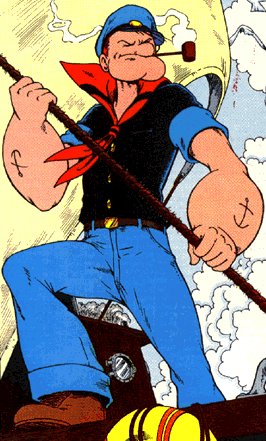
Fifth Entry: Popeye's surprising scholarly influence

The Riddle of the Frozen Flames, Mary & Thomas Hanshew, 1929, p.179


...have seen the two tough-looking sailormen who descended from the first-class compartment there and stepped on to the tiny platform among one or two others, he would never have dreamed of associating them with the Mr. Headland and his man Dollops who had such a short time ago left the Towers for London.
    Which is just as well, as it happened, for it was with Borkins that Cleek and Dollops were most concerned.  Upon the probability of their friendship with the butler hung the chance of their getting work.  They had left Mr. Narkom to go up to London and keep his eyes open for any clues in the bank robberies case, and had promised to report to him as soon as possible, if there were anything to be gleaned at the factory.  Mr. Narkom had expressed his doubts about it, had told Cleek that he really did not see how any human agency could possibly get Nigel Merriton off, with such appalling evidence to damn him.  And what an electrical factory could have to do with it...!
    "You forget the good Borkin's connection with the affair," returned Cleek, a trifle sharply, "..."and you forget another thing.  And that is, that I have found the man who attempted my life, and mean eventually to come to grips with him.  That is the only reason why I did not speak at the inquest this afternoon.  I am going to bide my time, but I'll have the beggar in the end.  If working for a time at an electrical factory is going to help on matters, then work there I'm going to, and Dollops with me...
    "If there should be need of me, don't forget that I am Bil Jones, sailorman, once of Jamaica, now of the Factory, Saltfeelt.  And stick to the code.  A wire will fetch me.  He hopped out upon the platform...


"...two tough looking sailormen..."


I initially struggled with this passage, nothing really prompting any thoughts.  Just as I was beginning to despair, one of my childhood heroes barged into mind, saving this blog entry and plastering my face with a childish grin.


He's Popeye, the sailor man!
About a year ago I read that the common misconception about the strength imbuing properties of spinach is the result of a typo in some 1870s German report.  Apparently the iron content of this vegetable was printed one spot too far to the right.  Wikipedia disputes this, claiming it an urban myth.  With whom do I place my naive trust, the at times hilarious Cracked.com, or the democratic aggregate knowledge centre, Wikipedia?  In these times of confusion and crisis one can only find answers at the true source of all knowledge.


Just kidding.

Stephen Fry, the greatest repository of information the world has ever known.
On  his enjoyable, amusing and informative program, QI (Quite Interesting), Fry asks his panel (usually consisting of comedians, clever people, actors and the like) which green vegetable has ten times more iron than average.  Spinach is not the correct answer, its adamant and incorrect proposal celebrated with sirens and some small measure of embarrassment for the contestant that voiced the obvious and predictable.  Here it is for you.


OK, so he doesn't actually mention the typo nor the report, our favourite sailor man isn't included at all.  On re-examination of the Wikipedia spinach article, I have noticed that the author has substantiated his claim with a reference:  a PDF from the Internet Journal of Criminology; 'Spinach, Iron and Popeye: Ironic lessons from biochemisty and history on the importance of healthy eating, healthy scepticism and adequate citation. '  Thirty-four pages detailing an articulated research response to our(my) question.  It's actually a decent read.  I now don't really care about the non/existence report now (which the author of this journal article concludes has not been found, but does not deny that it may have existed and may still materialize), being much more impressed with my forgotten hero Popeye and his capacity to prompt academic investigation and scholarly rumination.

I always thought it would be Optimus.

Thursday, 17 November 2011

Fourth Entry: 'The Dark Flower' - A dismal display of attraction and a high priced middle finger

  
The Dark Flower, John Galworthy, Charles Scribners Sons, 1913, p.170
ments.  Never did anyone try less to fascinate.  He could not recall one single little thing that she had done to draw him to her.  Was it, perhaps, her very passivity, her native pride that never offered or asked anything, a sort of soft stoicism in her fibre; that and some mysterious charm, as close and intimate as scent was to a flower?
He waited to open till he heard her footsteps just outside.  She came in without a word, not even looking at him.  And he, too, said not a word till he had closed the door, and made sure of her.  Then they turned to each other.  Her breast was heaving, a little, under her thick frock, but she was calmer than he, with that wonderful composure of pretty women in all the passages of love, as who sould say: This is my native air!
They stood and looked at each other, as if they could never have enough, till he said at last:
"I though I should die before this moment came.  There isn't a minute that I don't long for you so terribly that I can hardly live."
"And do you think that I don't long for you?"
"Then come to me!"
She looked at him mournfully and shook her head.
Well, he had known that she would not.  He had not earned her.  What right had he to ask her to fly against the world, to brave everything, to have such faith in him - as yet? He had no heart to press his words, beginning then to understand the paralyzing truth that there was no long an re-

"...she was calmer than he, with that wonderful composure of pretty women in all the passages of love..."

I doubt it would surprise any reader that this passage, with its dramatic and passionate overtones, conjured memories of past romantic, intimate and physical liaisons.  Don't worry, I'm not going to launch into any sort of tawdry boasting or claims of exaggerated prowess.  I wasn't too sure of what I was going to write without having to tread down the ex-girlfriend path.  On further reflection and repeated readings I began to identify with how a person can be momentarily robbed of their faculties simply by the presence of another.

A few years ago I was welcoming the arrival of the new year at a lock-in at a bar where we knew the staff and management.  I had finished a long day and night of work, so I was pretty tired.  Sitting with my boss and one of the bouncers from another bar, I noticed a girl walk in.  She was simply beautiful.  "Who's the brunette?" my question laced with awe and wonder.  My boss got up and brought her over to our table, telling her exactly what I had just asked (to no one in particular I thought).  She delicately sat herself adjacent to me, crossed her legs, placed both hands on one knee, looked me straight in the eye and genuinely smiled.  "Hello Luke, how has your New Year's been?"  I could only reply with some sort of guttural sound and incoherent stammering whilst my eyes sagged to the floor.  Not a charming display.  She probably assumed that I was drunk (it was four - five o clock in the morning), after a few moments she diverted her attention to a person from whom she could elicit words, articulate sentences and something tantamount to wit.  My mature response was to quicken the pace of my drinking, the effects of which was intensified by a long split shift and a paucity of food, ultimately turning me into the drunken idiot she originally assumed I was.

"Never did anyone try less to fascinate."

I don't remember where, but a few years ago I read an article about extravagant displays of wealth in people's homes and offices.  The line I remember most, and I am loosely paraphrasing, was that 'spending a great sum of money on a sculpture/piece of art and giving it maximum exposure (a landing/entry area) is a grand way of extending a giant middle finger to colleagues, competitors and associates'  Does this belie a fulfilling existence?  It would be easy to say no, but my life infrequently intersects with the lives of high-earning peoples, so I'm not really in a position to judge, let alone dictate how they should best spend their money.  Acquiring and strategically placing a ludicrously expensive piece of art for the purpose of telling someone to go fuck themselves might to some be quite immature.  I like the subtlety and lack thereof, but mostly, I applaud the effort.


Which one makes the greater impression on you?

Thursday, 3 November 2011

Third Entry: 'Wet Magic', The Clash and a good kick in the arse

Wet Magic, Edith Nesbit, Kesinger Publishing 2004 - p.37
...impossible in these latitudes.  Do you know anything about the rope they caught me with"
"No," said Bernard and Kathleen.  But the others said, "it was a lariat."
"Ah." said the Mermaid, "my worst fears are confirmed - But who could have expected a lariat on these shores?  But that must have been it.  Now I know why, though I have been on the point of working the magic of the Great Storm at least five hundred times since my capture, some unseen influence has always held me back."
"You mean," said Bernard, "you feel that it wouldn't work, so you didn't try."
A rattling, ripping sound outside, beginning softly, waxed louder and louder so as almost to drown their voices.  It was the drum, and it announced the beginning of the circus.  The Spangled Child put his head in and said, "Hurry up or you'll miss my Infant Prodigious Act on the Horse with the Tambourines, " and took his head out again.
"Oh dear, " said Mavis, "and we haven't arranged a single thing about rescuing you.
"No more you have." said the Mermaid carelessly.
"Look here," said Frances, "you do want to be rescued, don't you?"
"Of course I do," replied the Mermaid impatiently, "no I know about the llama rope.  But I can't walk even if they'd let me, and you couldn't carry me.  Couldn't you come at dead of night with a chariot - I could lift myself into it with your aid - then you could drive swiftly hence, and driving into the sea I could drop from the chariot and escape while you swam ashore."
"I don't believe we could - any of it," said Bernard, "let alone swimming ashore with horses and chariots.  Why, Pharaoh himself couldn't do that, you know."  And even Mavis and Frances added helplessly. "I don't see how we're to get a chariot," and "Do think of some other way."
I shall await you." said the lady in the tank with perfect calmness, "at dead of night."


"...anything about the rope they caught me with?"


I like punk rock - not all of it, but much of.  The Clash I am especially enamoured with, particularly for the way in which their music evolves over their decade-long existence.  Their first and last songs, 'White Riot' and 'This Is England' really demonstrate the band's progression.  Their early stuff is exactly what you'd expect from a late 1970s British punk band, the scratchy half shouted vocals combined with the drum beats and guitars evoking images of mo-hawks and safety pinned nostrils.  Then something changes with their cover of 'Police and Thieves' and you know it from the first guitar strum; a foreign influence that is to be further applied in later offerings.  I love charting the band's musical progression and listening the influences that underscores each song; politics, society, reggae, ska, you name it.
Incorporating different styles from the influences of burgeoning cultural groups in Britain, The Clash transcend punk rock and freed their music from the encumbrances of genre and the predestination of musical identity.  Potent lyrics across their discography and a shifting musical experimentation explains their ongoing influence, but also why I enjoy blasting their songs and badly singing along.

"You feel that it wouldn't work, so you didn't try."

This is something that has definitely applied to me at various points in my life.  There have been times when I wouldn't try something for fear that it wouldn't work, or that I would convince myself that to try was an exercise in futility.  Doomed to fail, so what's the point?  At many times, what I have needed is what's commonly known as 'a good kick in the arse'.  I am fortunate today to have received two such kicks in my mid-twenties, without which I honestly don't know what I would be doing or where I would right now be.

The first kick was provided by one of my closest friends after dinner one night.  About what we were conversing, I'm not sure, but her voice suddenly became a mix of exasperation and concern, taking a scathing edge; "When are you going to stop dicking around behind a bar and actually do something?" We discussed a return to university, but I was despondent; I knew myself too well, that I had no discipline and would fuck it up. Again. After further discussion and an assessment of my situation, I determined to apply, not only to university, but myself.

The second kick came a few months after the first and also involved a memorable moment.  I had always been determined to spend some time working in the United Kingdom.  I had spoke about it for a number of years and promised many British travellers that I had met and worked with, that I would see them soon.  I was totally useless in fulfilling these promises.  Again, no discipline.  Another one of my closest friends was visiting from the U.K., having brought his girlfriend over as well.  Whilst we were utterly inebriated and urinating he told me of his intent to propose and asked me to be his Best Man should she accept.  After having restored my penis to my underwear, I told him that I would be honoured and we embraced in a manly fashion (let me clarify now that he too had confined his member to jeans and underwear).  She accepted and I suddenly had to save for a trip to the motherland.

A year in the U.K., living in youth hostels and sleeping on couches. Time back-packing across England and Europe, meeting and working with great people (and a couple of arseholes along the way), drinking myself into oblivion (quite literally at one point), a winter with snow and ice, long train trips over foreign lands and even a couple of romances; that year was quite an experience.

These were formative moments from which I have learned and grown. I'm sure there will be times when I will be in need of additional 'kicks', and I can only hope that in the spirit of good friendship there will be those whom are will to take aim and swing their boot.